

A new study tracked every former NFL player who died over a 14-year period and examined hundreds of donated brains. The findings are the most rigorous evidence yet that repetitive head trauma causes lasting harm, and they raise real questions about how the legal system accounts for damage that, until now, could only be confirmed after death.
Quick Takeaways
- What the new NFL CTE study found
- What CTE is and why it can't be diagnosed in the living
- Why this isn't just a football problem
- What the findings mean for your legal rights in California
- Warning signs after a head injury
On August 26, 2026, one of the most rigorous studies ever conducted on chronic traumatic encephalopathy (CTE) was published in The BMJ. Unlike most CTE research before it, this study didn't start with a small group of brains donated by families who already suspected something was wrong. Researchers instead built a complete, fully enumerated list of every former NFL player known to have died between 2008 and 2021 — 1,712 men — and examined the 338 brains that were donated for study. The result was that 93.2% of those donated brains showed neuropathologically confirmed CTE.
As a San Francisco attorney who represents people with traumatic brain injuries, I don't spend most of my time arguing about football. I spend it representing rideshare passengers, delivery drivers, cyclists hit crossing Market Street, construction workers, and people who fell on a cracked sidewalk in the Sunset. But this study matters to every one of them, because it's some of the strongest population-level evidence yet that repetitive trauma to the brain causes real, measurable, sometimes devastating harm. It exposes just how often that harm goes officially unrecorded. Here's what the research found, what CTE actually is, and what it means for your rights if a head injury has touched your life.
What the New NFL CTE Study Found
Most earlier CTE research relied on brains donated to a handful of specialized brain banks — a group that tends to overrepresent players whose families already suspected something was wrong before death, skewing the numbers upward. This study took a different, more defensible approach and started with everyone.
Researchers identified all 1,712 former NFL players known to have died between 2008 and 2021, then examined the 338 brains (about 1 in 5 of that group) that were donated through the UNITE Brain Bank and the University of California, San Francisco Alzheimer's Disease Research Center. Pathologists examined the tissue without being told anything about each player's career or symptoms while alive, to keep the results unbiased.
What they found:
- 315 of the 338 donated brains (93.2%) showed neuropathologically confirmed CTE.
- Accounting for the players whose brains were never examined, and applying the most conservative assumptions possible, researchers calculated that CTE prevalence across the full 1,712-person cohort was at least 18.5% and could be as high as 98.7%.
- Among players who died between 2016 and 2021, when brain donation was most common, the confirmed minimum climbed to 24.5% — meaning at least 1 in 4 former players who died in that window had CTE.
- 104 donors (30.8%) had Stage IV CTE, the most severe classification on the disease's four-stage scale.
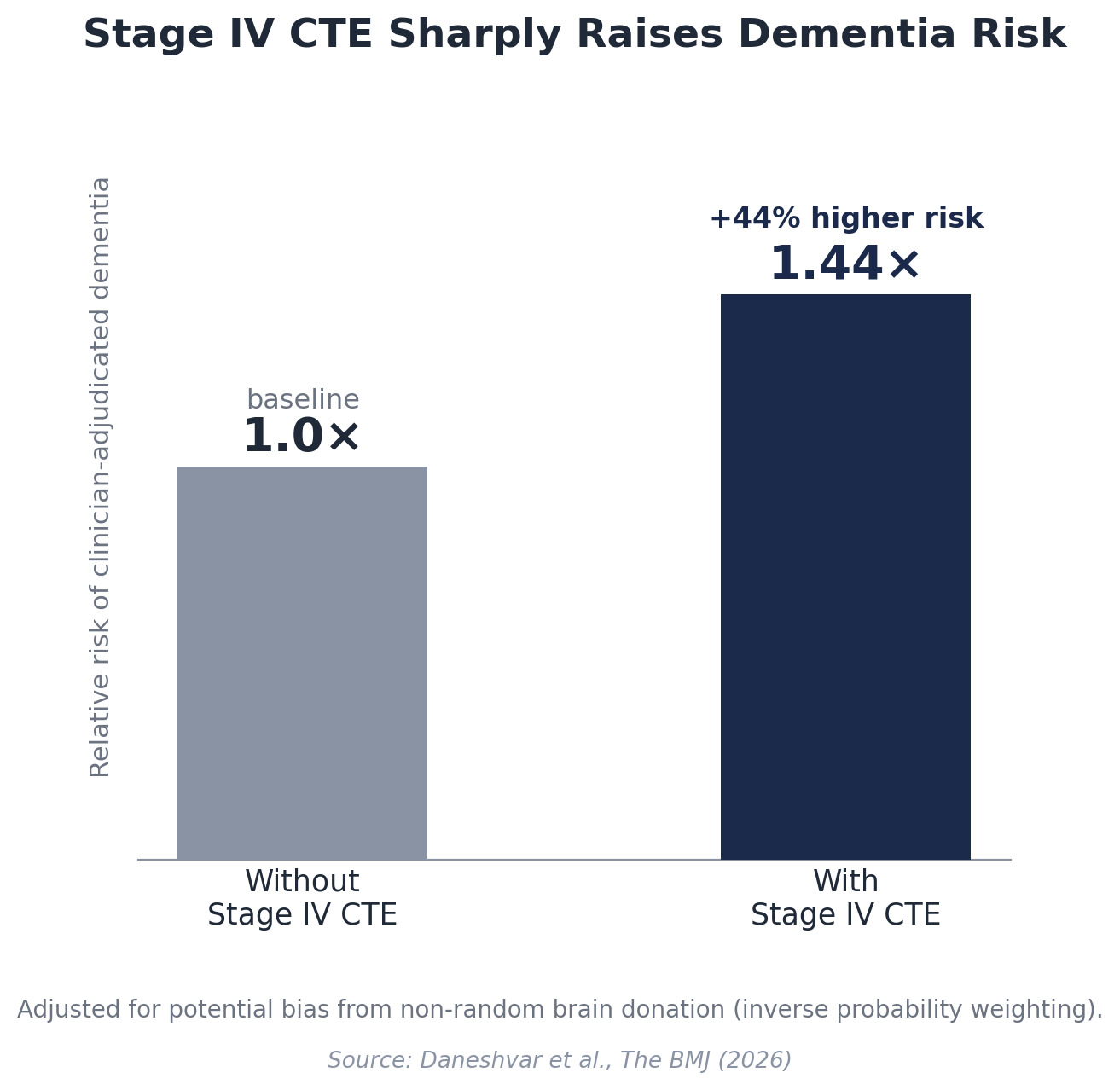
- Donors with Stage IV CTE had a 44% higher risk of a clinically diagnosed dementia than donors without it, even after researchers statistically corrected for the fact that brain donors aren't a random sample of all players.
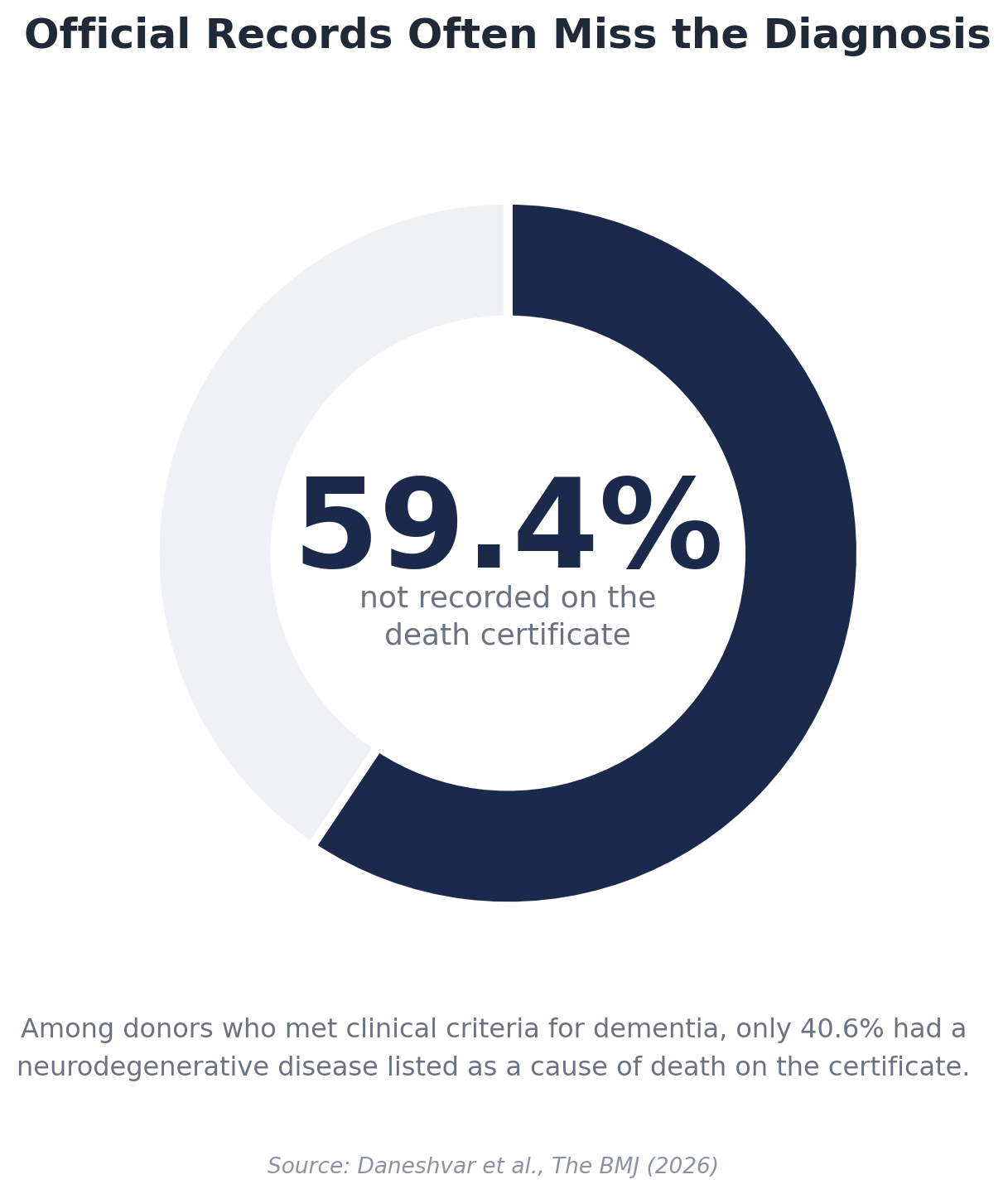
- Perhaps most relevant to anyone working in personal injury law: only 40.6% of donors whose medical records supported a dementia diagnosis actually had a neurodegenerative disease listed anywhere on their death certificate. The official paperwork missed the diagnosis more often than it caught it.
The researchers were candid about the limits of their own work. Brain donation still wasn't random. CTE prevalence "at death" isn't the same thing as prevalence among all living players. And because this is an observational study, it shows a strong statistical association between severe CTE and dementia — not proof that CTE alone causes it. But the scale of this research, drawn from a complete population rather than a hand-picked sample, makes it one of the most credible pieces of evidence to date that repetitive head trauma leaves lasting, and often unrecorded, damage.
What Is CTE and Why Can’t Doctors Test for It?
Chronic traumatic encephalopathy (CTE) is a progressive brain disease associated with repeated impacts to the head — not necessarily diagnosed concussions, but the accumulation of blows over years or decades, including subconcussive hits that never produce obvious symptoms at the time they happen.
Here's the frustrating reality this study underscores: CTE can’t currently be diagnosed with certainty in a living person. It can only be confirmed by examining brain tissue after death for a specific pattern of abnormal tau protein around the brain's blood vessels. While someone is alive, doctors can identify probable CTE based on a documented history of head trauma combined with a cluster of symptoms, including memory problems, impaired judgment, mood changes such as depression or irritability, impulsivity, and, in advanced cases, dementia, but they can’t confirm the diagnosis outright.
Researchers classify CTE across four stages. Stage I typically involves mild, often unnoticed symptoms. Stage IV — the stage linked to a 44% higher dementia risk in this study — involves severe cognitive decline that, without a brain autopsy, can be difficult to distinguish from other dementias like Alzheimer's disease.
This diagnostic gap isn't just a medical curiosity. It's one of the central challenges facing anyone trying to hold a person, employer, school, or organization legally accountable for a brain injury's long-term consequences.
CTE and Traumatic Brain Injury Extend Beyond Football
Every headline about this study will focus on the NFL, and understandably so, since professional football players sustain an extraordinary number of head impacts over their careers. As I recently discussed in looking at the experiences of Kyle Shanahan and Roger Craig, the long-term effects of brain injury can take very different forms. But repetitive and single-incident traumatic brain injuries reach far beyond the football field, and they make up a significant share of personal injury cases here in the Bay Area:
- Car accidents, motorcycle crashes, and rideshare collisions — one of the most common causes of TBI, and among the most common case types we see, where dense San Francisco traffic and sudden stops make head trauma a real risk even in relatively low-speed crashes.
- Bicycle accidents and pedestrian crashes — a serious concern in a hilly, densely built city with heavy bike-commuter traffic and some genuinely dangerous intersections.
- Slip, trip, and fall accidents — on cracked sidewalks, poorly lit stairwells, wet retail floors, or construction sites.
- Workplace injuries, especially in construction, delivery, warehouse, and maritime work.
- Youth, high school, and recreational sports — soccer, ice hockey, rugby, cheerleading, and combat sports — all carry a risk of repetitive head impacts, and California schools and athletic leagues have specific legal duties regarding concussion protocols and return-to-play decisions.
- Assault and domestic violence, which can produce the same repetitive-impact patterns researchers associate with CTE.
- Defective products, including inadequately protective helmets and safety equipment.
Anyone in one of these situations can experience the same category of harm this study describes, and their family can face the exact same problem of proving that harm in a system that, as this research shows, often fails to record it accurately even in official documents like a death certificate.
What the NFL CTE Study Could Mean for California Brain Injury Claims
This is more than a medical headline. It has real, practical implications for how brain injury and wrongful death cases get built and argued.
It strengthens the scientific basis for repetitive-trauma claims. Insurance companies and defense attorneys routinely argue that a single accident, or a history of "minor" impacts, couldn't possibly explain the cognitive or behavioral symptoms someone is experiencing years later. A large, population-based study like this one — free of the selection bias that has limited smaller CTE studies in the past — gives injury attorneys stronger scientific footing to argue that repetitive head trauma causes real, lasting harm.
It shows how badly official records can undercount brain injury. If a death certificate misses a confirmed dementia diagnosis roughly six times out of ten, it's worth asking how often a hospital discharge summary, an insurance claim file, or a police incident report understates the true severity of a living person's brain injury. This is exactly why thorough documentation — neuropsychological testing, brain imaging, treating-physician records, and testimony from people who know the injured person well — matters so much in a TBI claim. The paperwork alone is often not enough.
It raises real questions about timing. In California, most personal injury and wrongful death claims must generally be filed within two years of the injury or death, under Code of Civil Procedure § 335.1. Because CTE can currently only be confirmed after death, and its connection to an earlier head injury may not become apparent until much later, families dealing with a loved one's cognitive decline or death may have a legitimate argument that their claim didn't fully "accrue" until that connection came to light. That's a genuinely complex, fact-specific question — precisely the kind of issue worth raising with an attorney early, rather than assuming too much time has already passed.
Government claims carry a much shorter deadline. If a brain injury occurred on a public road, a public school campus, a transit system, or other government property, California law generally requires that a formal claim be filed with that government entity within just six months — not two years (Government Code § 911.2 and related provisions). Missing that window can permanently bar an otherwise valid claim, which is why anyone with a possible TBI case involving a public entity shouldn't wait to get legal advice.
Wrongful death claims can involve CTE even outside of professional sports. If a loved one's judgment, balance, memory, or behavior declined in ways that contributed to a fatal accident — a fall, a crash, a medication error — and that decline may trace back to an earlier head injury, that connection is worth discussing with an attorney experienced in both traumatic brain injury and wrongful death claims.
Warning Signs After a Head Injury
Whether the injury happened yesterday or years ago, these symptoms deserve prompt medical attention and careful documentation:
- Headaches that worsen or won't resolve
- Confusion, disorientation, or gaps in memory
- Sensitivity to light or noise
- Balance problems or dizziness
- Sleep that's noticeably disrupted — far more or far less than usual
- Noticeable changes in mood, patience, or personality
- Difficulty concentrating, planning, or making decisions
- Slurred speech or problems with motor coordination
If you notice these signs in yourself or someone you love, especially following any blow to the head, even one that didn't seem serious at the time, see a doctor and keep a record of every visit, symptom, and diagnosis. That documentation protects your health. If someone else's negligence caused the injury, that too protects your legal rights.
Why Work With a San Francisco Brain Injury Attorney?
TBI and CTE-related cases are not standard personal injury claims. They call for an attorney who knows how to work with neurologists, neuropsychologists, and life-care planners; who understands how to document an injury that often doesn't show up cleanly on a CT scan; and who knows San Francisco's hospitals and medical community, including institutions like UCSF, which contributed to the very study discussed above.
At Choulos, Choulos & Wyle, brain injury and CTE-related claims aren't a side practice. They're a central focus of our work. We know how to build a case on real medical evidence rather than paperwork that, as this study shows, is often incomplete.
If you or someone you love has suffered a traumatic brain injury in a car accident, fall, workplace incident, sports injury, or another incident caused by someone else’s negligence, you don’t have to wait until you have every answer before protecting your legal rights.
Contact Choulos, Choulos & Wyle for a free, confidential consultation about your situation and any applicable deadlines. You can reach Claude A. Wyle directly by email at cwyle@ccwlawyers.com or call (415) 432-7290. Claude represents people with traumatic brain injuries, catastrophic injuries, and wrongful death claims throughout San Francisco and the Bay Area.
Frequently Asked Questions About CTE and Brain Injury Claims
Can CTE be diagnosed while someone is still alive?
Not with certainty. Doctors can identify probable or suspected CTE in a living patient based on symptoms and head-injury history, but a definitive diagnosis currently requires examining brain tissue after death.
How long do I have to file a brain injury lawsuit in California?
Generally, two years from the date of the injury or death, under California Code of Civil Procedure § 335.1. If a government entity — a city, county, school district, or transit agency, for example — is involved, you typically must file a formal administrative claim within six months instead.
Does CTE require repeated concussions, or can smaller hits add up?
Current research, including the framework behind this study, points to cumulative exposure to repetitive head impacts — including subconcussive hits that never produce obvious symptoms — rather than any single diagnosed concussion.
Can my family bring a claim if we believe a loved one's death was connected to an old, undiagnosed brain injury?
Potentially. This is a fact-specific and often complex question, particularly in light of how often this study shows death certificates miss a confirmed dementia diagnosis. An attorney can review your loved one's medical and injury history to evaluate whether a claim may still be viable.
Is CTE only a concern for professional athletes?
No. Most public research and media coverage focuses on football, but the same underlying biology applies to anyone with a history of repetitive head trauma, including car accidents, workplace injuries, youth and amateur sports, military service, and domestic violence.
What if I was partly at fault for the accident that caused my brain injury?
California follows a "pure comparative negligence" rule, meaning you can generally still recover compensation even if you were partly at fault. Your award is simply reduced by your percentage of responsibility. Being partially at fault doesn’t automatically disqualify you from a claim.
What compensation can a traumatic brain injury claim recover?
Depending on the facts of your case, compensation may include past and future medical expenses, lost income and diminished earning capacity, the cost of long-term or life-care planning, and pain and suffering. In a wrongful death case, surviving family members may also be able to recover for loss of financial support and companionship. An attorney can evaluate what applies to your specific situation.
This blog post is for general informational purposes only and doesn’t constitute legal advice, nor does it create an attorney-client relationship. Every case depends on its own facts, and you should consult a licensed California attorney about the specific circumstances of your situation. Attorney Advertising.


